When I first lived in Italy 25 years ago, Valentino was the name of our plumber and of a boy at my daughter’s nursery school. Valentine’s Day—la festa di San Valentino—was celebrated in cities where San Valentino was the patron saint. No matter! In the days leading up to February 14th, I bought red and pink construction paper, white doilies, purple magic markers and glue, cutting out hearts and arrows to make Valentine’s cards for my family, just as my father had done for us. I bought white (“Friends”) and red (“Crush”) carnations like the ones we sent and received in grade school. I baked a heart-shaped cake and placed a little white box filled with pink and red candy at each table setting, the way my mother had. We celebrated just like I had growing up in America.
In my early years in Siena, Valentine’s Day barely made a ripple in the run up to the much more important Carnevale. Now, Valentine’s Day in Italy has evolved into the Hallmark holiday we know so well: every restaurant in town is filled with two-tops, heart-shaped boxes of candy appear in the supermarket by early February, and roses are sold out by noon on the 14th. While this may not be the Valentine’s Day I knew and loved as a girl, it’s hardly bad news. When it comes to love, more is more.
Does this trend prove that Italian culture is being Americanised? I wonder. The Siena I knew then, with its mom-and-pop shops selling dried figs and fresh ricotta, or ceramic bells, or linens with the orange and black embroidery of “Punto Senese” is long gone. Many of those small stores have been replaced by franchises of Occitaine and Calzedonia, which one could find in any European city. It’s not so much Americanisation as general commercialisation.
Italians don’t seem particularly threatened: Dante’s tongue is increasingly dotted with English, hamburger joints seem to spring up on every corner, and yet, when I returned to Siena last week after months away, life here still felt as distinct from life in the U.S. as ever. Attentive, indulgent parenting, fundamental ties to the Catholic Church, and the culto del bello e del buono—the cult of what’s beautiful and what’s delicious—continue to thrive, undisturbed by Halloween, Netflix or Uber.
I find the same is true of me: despite the trappings of Italian-ness, I still feel thoroughly American, most notably when I come back here after having been in the States.
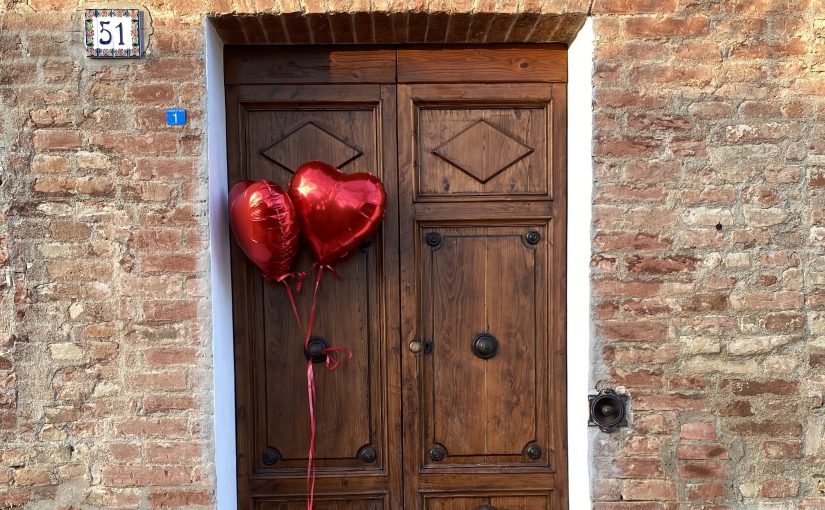
Last Friday, I decorated the dining room with heart-shaped balloons and baskets of miniature red roses. I baked a layer cake from the same pan I always have. As I was setting the table, I thought of my first Valentine’s Day in Italy. At the time, I lived with my mother-in-law, who, that afternoon, came upon me in the dining room and gasped, “What are you doing?”
“Setting the table for a Valentine’s Day supper,” I explained.
“Why the candles?” she croaked. “It looks like an altar.”
“Nonsense,” I answered, used to scoffing at her old-fashioned ideas. But when she had left, I stood back and surveyed the scene. The two red candles in their silver holders suddenly held sway over the whole table and brought to mind more somber settings, more important feasts.
To this day, I resist lighting candles. I can’t help feeling that they lend unwanted pretence to otherwise casual scenes. It seems I can no longer separate candles from church. Perhaps part of me really has become Italian after all.
 The Truth About Tuscany