Candele

When I first lived in Italy 25 years ago, Valentino was the name of our plumber and of a boy at my daughter’s nursery school. Valentine’s Day—la festa di San Valentino—was celebrated in cities where San Valentino was the patron saint. No matter! In the days leading up to February 14th, I bought red and pink construction paper, white doilies, purple magic markers and glue, cutting out hearts and arrows to make Valentine’s cards for my family, just as my father had done for us. I bought white (“Friends”) and red (“Crush”) carnations like the ones we sent and received in grade school. I baked a heart-shaped cake and placed a little white box filled with pink and red candy at each table setting, the way my mother had. We celebrated just like I had growing up in America.

In my early years in Siena, Valentine’s Day barely made a ripple in the run up to the much more important Carnevale. Now, Valentine’s Day in Italy has evolved into the Hallmark holiday we know so well: every restaurant in town is filled with two-tops, heart-shaped boxes of candy appear in the supermarket by early February, and roses are sold out by noon on the 14th. While this may not be the Valentine’s Day I knew and loved as a girl, it’s hardly bad news. When it comes to love, more is more.

Does this trend prove that Italian culture is being Americanised? I wonder. The Siena I knew then, with its mom-and-pop shops selling dried figs and fresh ricotta, or ceramic bells, or linens with the orange and black embroidery of “Punto Senese” is long gone. Many of those small stores have been replaced by franchises of Occitaine and Calzedonia, which one could find in any European city. It’s not so much Americanisation as general commercialisation.

Italians don’t seem particularly threatened: Dante’s tongue is increasingly dotted with English, hamburger joints seem to spring up on every corner, and yet, when I returned to Siena last week after months away, life here still felt as distinct from life in the U.S. as ever. Attentive, indulgent parenting, fundamental ties to the Catholic Church, and the culto del bello e del buono—the cult of what’s beautiful and what’s delicious—continue to thrive, undisturbed by Halloween, Netflix or Uber.

I find the same is true of me: despite the trappings of Italian-ness, I still feel thoroughly American, most notably when I come back here after having been in the States.

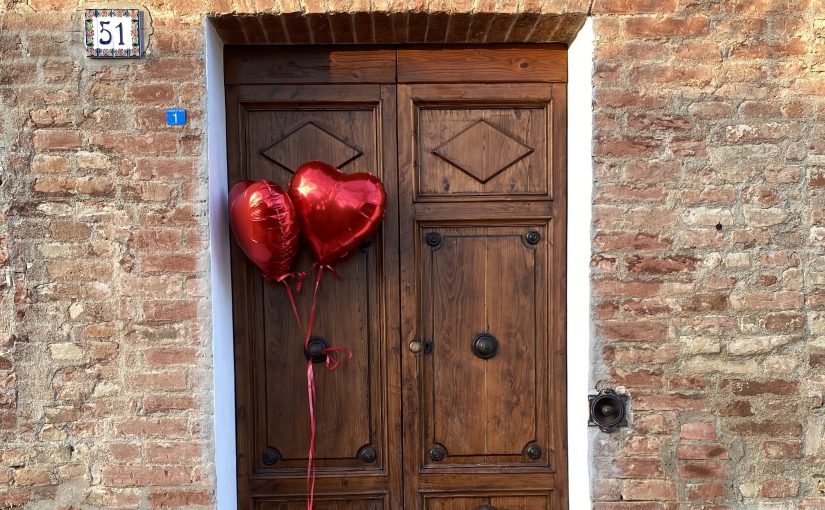
Last Friday, I decorated the dining room with heart-shaped balloons and baskets of miniature red roses. I baked a layer cake from the same pan I always have. As I was setting the table, I thought of my first Valentine’s Day in Italy. At the time, I lived with my mother-in-law, who, that afternoon, came upon me in the dining room and gasped, “What are you doing?”

“Setting the table for a Valentine’s Day supper,” I explained.

“Why the candles?” she croaked. “It looks like an altar.”

“Nonsense,” I answered, used to scoffing at her old-fashioned ideas. But when she had left, I stood back and surveyed the scene. The two red candles in their silver holders suddenly held sway over the whole table and brought to mind more somber settings, more important feasts.

To this day, I resist lighting candles. I can’t help feeling that they lend unwanted pretence to otherwise casual scenes. It seems I can no longer separate candles from church. Perhaps part of me really has become Italian after all.

Aperitutto

A few years ago, chalkboard signs advertising “Apericena” started appearing outside bars here in Italy—cheap bars in the provinces, not swanky lounges in Milano. It had long been possible to order an evening drink (at the same bar where you took your morning coffee) and sip it while standing at the counter and munching on beer nuts, or, often, slices of focaccia or panini unashamedly sliced from the remains of the lunch rush. For students or anyone else on a tight budget, this was one way to spend your supper budget on drinks and still get something of a meal. I remember when I started hearing the word “apericena” used, tentatively, by friends. “Let’s meet for an aperitivo,” Nadia would suggest. “No–an ‘apericena,’” she’d correct herself, playfully trying out the new expression. We took to the concept fast. A combination of the words “aperitivo” and “cena” (dinner), “apericena” suggests a light meal. The word conveys parsimony, too: we wouldn’t be splurging on a rich dinner, just treating ourselves to a drink and a snack. Never mind that these “apericenas” often segued into meals; they started in a temperate spirit.

Lately, “apericena” has been moving in on entertaining at home. Tuscans have a “braccio corto,” it is said—a short arm. In other words, they hate to spend. Now that “apericena” is a thing, one can invite one’s friends over without committing to cooking and serving the three-course meal that’s the norm here. “Apericena” is low risk, too—who can’t pour chips into a bowl or set out a block of cheese? And non-committal: it’s understood that one hasn’t promised to satiate the guests.

In the US, restaurants and cafés are mostly selling munchies to their cocktail-drinking customers, not handing them out for free, as the bar near my house does when you buy a €3 Spritz. Still, even including the free snacks, the bars here must be earning a healthy profit. The bubbly wine they use for mixed drinks such as the Spritz has long ceased to be Venetian Prosecco; most bars use the least expensive spumante they can find. It costs €1 to make a Spritz, so even my bar can afford to provide peanuts.

I tried my first Spritz on a sunny terrace in the Dolomities in February of 2017. We had just stopped for lunch half-way around the Sella Ronda, the network of ski slopes west of Cortina, which one can ski all day, clockwise or counterclockwise, without needing to repeat a slope. It was my boyfriend’s parents that had introduced me to the luxury of having an aperitivo before lunch: at their country house in Castell’Anselmo near the Tuscan coast, they gathered in the living room just before 1:00pm for a glass of light white wine, or, around the holidays, Champagne, and pistachios and olives or slices of pecorino, while they waited for aunts, uncles and cousins to walk over from the other house, sons and daughters to arrive from Florence or Rome and grandchildren to come in from the yard. In the summer, a pitcher of Hugos was sometimes mixed: Prosecco, sambuca-flower syrup, lemon juice and fresh mint over ice—a cocktail that epitomizes summer, whereas a Spritz is intrinsically linked to winter for me.

As anyone who has been to a bar in Europe in the last five years knows, Prosecco, Prosecco-based cocktails and especially Spritzes have taken over café tables from Oslo to Otranto. Last Friday night, sitting on the Piazza del Campo in Siena with my Goddaughter and her friend, we could see a Sprtiz on every table. Humans like sugar, and Aperol and Campari are sweet (26g and 24g of sugar per litre respectively), as well as tangy and bitter. Who invented the Sprtiz is a matter still contested–Was it a Venetian barman serving Select (yet another kind of bitter liqueur) with still white wine or the Padovans serving Aperol and bubbly?—as is the cause of the recent boom in the Spritz’s popularity, although the marketing department at Campari (which owns both Aperol and Campari) was no doubt key. And what is the best liqueur to use? Aperol for the neophyte, Campari for the sophisticates, Select and a squeeze of fresh orange for authenticity seekers. My favorite, Gamondi, is for the individualists!

My boyfriend’s family’s lunchtime “aperitivi” are no longer: his mother died a few years ago, and the family has stopped gathering for weekend, or even holiday, meals. Like everyone else, we’re eating and drinking less, watching our weight, our cholesterol, our blood pressure. Long, leisurely lunches hardly fit into our lives these days. Still, I hope the “apericena” will never entirely replace them.

Ringraziamento

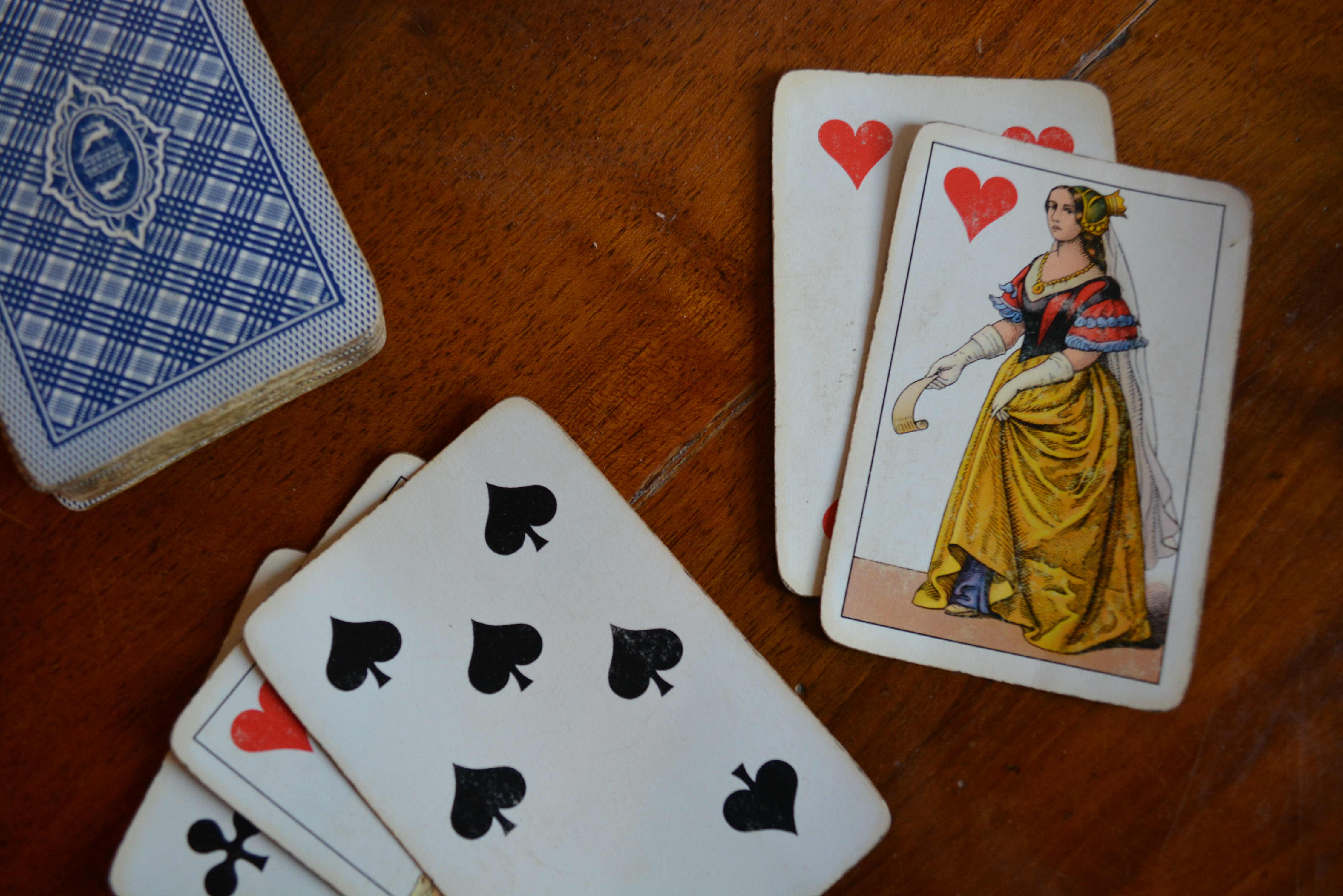
By now, the persimmon trees have lost their leaves, so the branches, covered in hundreds of round, orange-red fruits, stand out against the often-grey sky. The grapes and olives are harvested, but it’s too early to start pruning vines or trees. Leeks and fennel grow, without much attention, in the vegetable garden. We’ve eaten, for the time being, enough grilled mushrooms, mushroom pasta and mushroom risotto. It has started to rain, and it is the time of year when the thick-walled farmhouses feel colder than the scirrocco-driven dampness outside, so we come in, light the fire, drink tea and play briscola.

playing cards
Tuscan playing cards

On weekend mornings, we hear the dogs and gunshots of the hunters in the fields and woods around us. A friend brings me a piece of boar, which another friend makes into sausage and salami for us to hang in the cellar and eat this winter. Someone else brings chestnuts to a dinner party, and we sit up late around the fire with a good excuse to drink lots of wine. The ash of the fires and the dogs’ now always-muddy feet are reason enough to ease the housekeeping standards. Continue reading Ringraziamento

Bar Tips

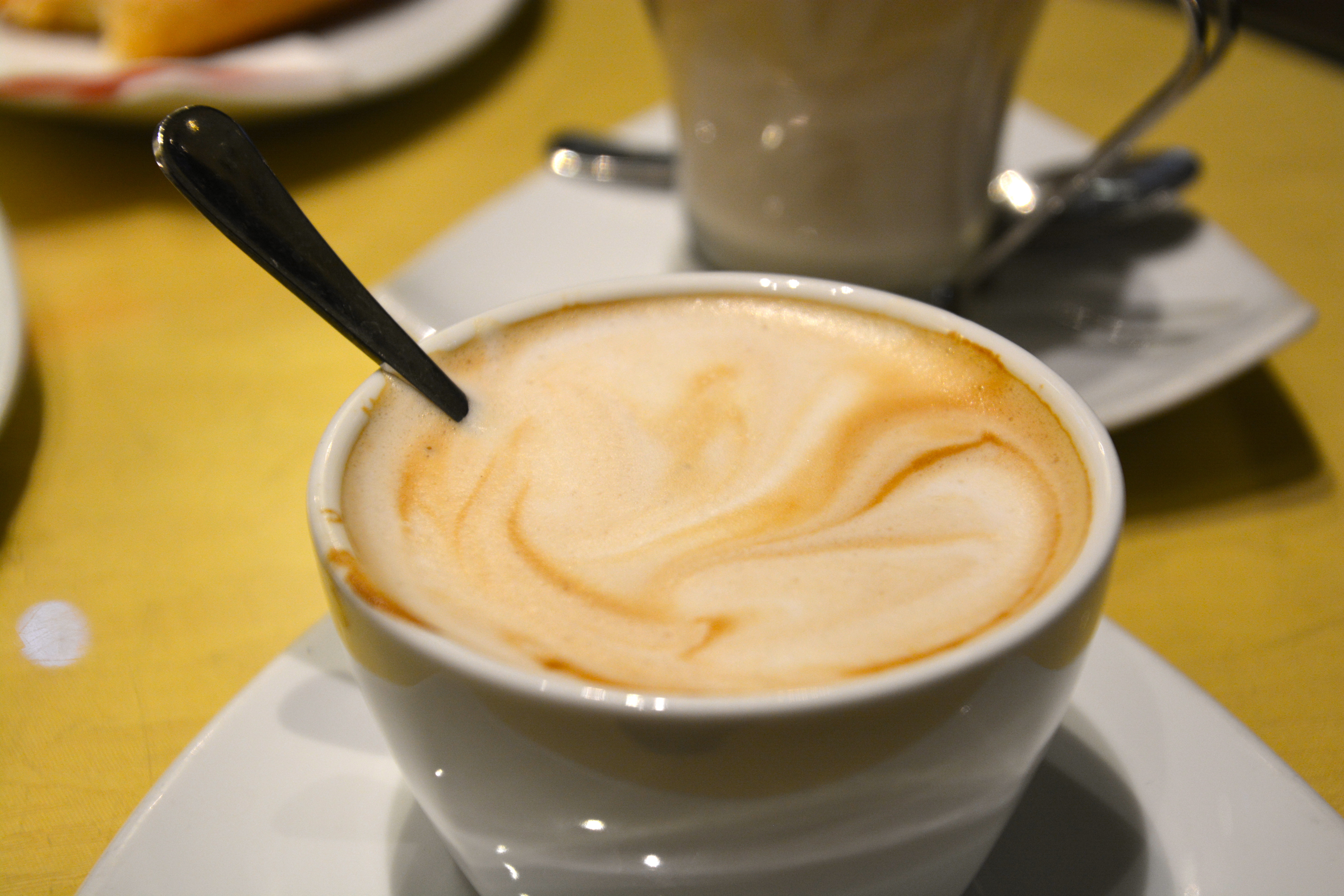
Foamy cappuccino in a cupTo those who come to me asking how to see “the real Tuscany,” I say, forget the Uffizzi, the wineries and the villas, and go to a bar—a bar in the Italian sense of the word, that is a café. Ah, you think, a welcome break in the pace and pressure of travel with family, twenty minutes to slip into neutral, park myself over a long, warm coffee, and shoot the breeze or flip through the paper. But that wouldn’t be Tuscany at all.

First, make your entrance. Open the door, step inside, and stop. The whole bar will turn and look you up and down (they know you’re American by now), at which point, stand tall, try to look bored and mildly disdainful, and scan the room, as if for danger or possible prey. Then, walk straight to the pastry counter. Order “un’ brioche,” which is the thing that looks like a croissant, or if you absolutely have to point, say “quella,” not “quello” because pastry is feminine. When you are handed your pastry in a napkin, resist the urge to thank anyone, and don’t smile; it looks suspicious so early in the day. Continue reading Bar Tips