Candele

When I first lived in Italy 25 years ago, Valentino was the name of our plumber and of a boy at my daughter’s nursery school. Valentine’s Day—la festa di San Valentino—was celebrated in cities where San Valentino was the patron saint. No matter! In the days leading up to February 14th, I bought red and pink construction paper, white doilies, purple magic markers and glue, cutting out hearts and arrows to make Valentine’s cards for my family, just as my father had done for us. I bought white (“Friends”) and red (“Crush”) carnations like the ones we sent and received in grade school. I baked a heart-shaped cake and placed a little white box filled with pink and red candy at each table setting, the way my mother had. We celebrated just like I had growing up in America.

In my early years in Siena, Valentine’s Day barely made a ripple in the run up to the much more important Carnevale. Now, Valentine’s Day in Italy has evolved into the Hallmark holiday we know so well: every restaurant in town is filled with two-tops, heart-shaped boxes of candy appear in the supermarket by early February, and roses are sold out by noon on the 14th. While this may not be the Valentine’s Day I knew and loved as a girl, it’s hardly bad news. When it comes to love, more is more.

Does this trend prove that Italian culture is being Americanised? I wonder. The Siena I knew then, with its mom-and-pop shops selling dried figs and fresh ricotta, or ceramic bells, or linens with the orange and black embroidery of “Punto Senese” is long gone. Many of those small stores have been replaced by franchises of Occitaine and Calzedonia, which one could find in any European city. It’s not so much Americanisation as general commercialisation.

Italians don’t seem particularly threatened: Dante’s tongue is increasingly dotted with English, hamburger joints seem to spring up on every corner, and yet, when I returned to Siena last week after months away, life here still felt as distinct from life in the U.S. as ever. Attentive, indulgent parenting, fundamental ties to the Catholic Church, and the culto del bello e del buono—the cult of what’s beautiful and what’s delicious—continue to thrive, undisturbed by Halloween, Netflix or Uber.

I find the same is true of me: despite the trappings of Italian-ness, I still feel thoroughly American, most notably when I come back here after having been in the States.

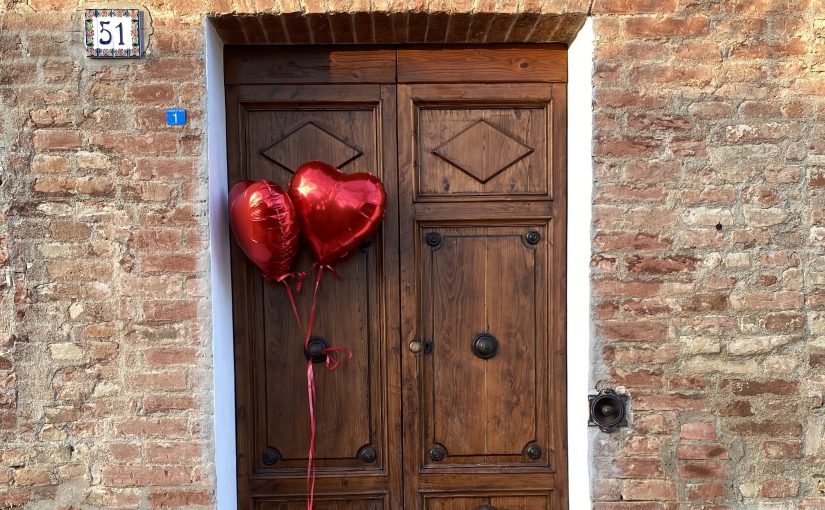
Last Friday, I decorated the dining room with heart-shaped balloons and baskets of miniature red roses. I baked a layer cake from the same pan I always have. As I was setting the table, I thought of my first Valentine’s Day in Italy. At the time, I lived with my mother-in-law, who, that afternoon, came upon me in the dining room and gasped, “What are you doing?”

“Setting the table for a Valentine’s Day supper,” I explained.

“Why the candles?” she croaked. “It looks like an altar.”

“Nonsense,” I answered, used to scoffing at her old-fashioned ideas. But when she had left, I stood back and surveyed the scene. The two red candles in their silver holders suddenly held sway over the whole table and brought to mind more somber settings, more important feasts.

To this day, I resist lighting candles. I can’t help feeling that they lend unwanted pretence to otherwise casual scenes. It seems I can no longer separate candles from church. Perhaps part of me really has become Italian after all.
Ognissanti

Last Friday, schools and businesses were closed here in Italy to celebrate All Saints Day, which marks the start of a holiday season that will end in January with Epiphany on the 6th. From now until then, meals take on even more than their usual importance.

When I first came to live in Italy, and the holidays came around, I couldn’t wait to use the damask tablecloth, to get the Ginori out of the china closet, to dust off the Murano glasses. I thumbed through recipes for what I considered the most elegant dishes—watercress soup, roasts of ham, goose or beef, stuffings, gravies and creamed vegetables, trifles, multi-layer cakes and holiday punch. But I needn’t have gone to the trouble.

First, I wasn’t going to be entrusted with any cooking. (On my third Christmas here, I got to boil potatoes for a purée.) And second, holiday meals here are made up of dishes that are eaten at the family table throughout the season—pasta with ragù, roast beef, winter vegetables—and the table is set just as it always is with a faded but ironed tablecloth, plain china, two stemless glasses per person and the scratched but sturdy old silver. The attention to procuring the best ingredients is par for the course: each woman (because here it is still very much the women in the house that plan the holidays) knows a butcher who gives her the tenderest cuts and a farmer who will save her the freshest bunch of spinach. And the cooking is as rigorous as ever, the pasta exactly al dente, the sauce simmered and corrected all afternoon, the roast delicately crisped on the outside, al sangue within and sliced as thin as a wafer. Wine is served–here in Tuscany, it’s the light, tangy, unadulterated local Sangioveses that so effortlessly accompany the hearty cuisine. Desserts are tied to the holiday: pan coi santi (a nutty raisin bread) on All Saints’ Day, Panettone or Pandoro on Christmas and clementines and chestnuts throughout the winter.

Each child can ask for a present and husbands and wives buy one another a sweater or a scarf, but gifts are hardly the focus. The main meal on any of these holidays is often lunch rather than dinner, and afterwards, it’s customary to go for walk. Then, cards are played and naps are taken, until suppertime, when the fire is rekindled, someone pulls out the leftovers and the table is set again.

I miss my family and our traditions keenly during the holiday season—my dad playing the Messiah CD around the clock for a month, my mom’s homemade cranberry sauce and succulent roast goose, watching football on Thanksgiving and opening presents in our pyjamas on Christmas morning. But, after twenty four years, the Italian traditions–especially simple, savory food and pure, refreshing wine—are becoming mine, too.

Aperitutto

A few years ago, chalkboard signs advertising “Apericena” started appearing outside bars here in Italy—cheap bars in the provinces, not swanky lounges in Milano. It had long been possible to order an evening drink (at the same bar where you took your morning coffee) and sip it while standing at the counter and munching on beer nuts, or, often, slices of focaccia or panini unashamedly sliced from the remains of the lunch rush. For students or anyone else on a tight budget, this was one way to spend your supper budget on drinks and still get something of a meal. I remember when I started hearing the word “apericena” used, tentatively, by friends. “Let’s meet for an aperitivo,” Nadia would suggest. “No–an ‘apericena,’” she’d correct herself, playfully trying out the new expression. We took to the concept fast. A combination of the words “aperitivo” and “cena” (dinner), “apericena” suggests a light meal. The word conveys parsimony, too: we wouldn’t be splurging on a rich dinner, just treating ourselves to a drink and a snack. Never mind that these “apericenas” often segued into meals; they started in a temperate spirit.

Lately, “apericena” has been moving in on entertaining at home. Tuscans have a “braccio corto,” it is said—a short arm. In other words, they hate to spend. Now that “apericena” is a thing, one can invite one’s friends over without committing to cooking and serving the three-course meal that’s the norm here. “Apericena” is low risk, too—who can’t pour chips into a bowl or set out a block of cheese? And non-committal: it’s understood that one hasn’t promised to satiate the guests.

In the US, restaurants and cafés are mostly selling munchies to their cocktail-drinking customers, not handing them out for free, as the bar near my house does when you buy a €3 Spritz. Still, even including the free snacks, the bars here must be earning a healthy profit. The bubbly wine they use for mixed drinks such as the Spritz has long ceased to be Venetian Prosecco; most bars use the least expensive spumante they can find. It costs €1 to make a Spritz, so even my bar can afford to provide peanuts.

I tried my first Spritz on a sunny terrace in the Dolomities in February of 2017. We had just stopped for lunch half-way around the Sella Ronda, the network of ski slopes west of Cortina, which one can ski all day, clockwise or counterclockwise, without needing to repeat a slope. It was my boyfriend’s parents that had introduced me to the luxury of having an aperitivo before lunch: at their country house in Castell’Anselmo near the Tuscan coast, they gathered in the living room just before 1:00pm for a glass of light white wine, or, around the holidays, Champagne, and pistachios and olives or slices of pecorino, while they waited for aunts, uncles and cousins to walk over from the other house, sons and daughters to arrive from Florence or Rome and grandchildren to come in from the yard. In the summer, a pitcher of Hugos was sometimes mixed: Prosecco, sambuca-flower syrup, lemon juice and fresh mint over ice—a cocktail that epitomizes summer, whereas a Spritz is intrinsically linked to winter for me.

As anyone who has been to a bar in Europe in the last five years knows, Prosecco, Prosecco-based cocktails and especially Spritzes have taken over café tables from Oslo to Otranto. Last Friday night, sitting on the Piazza del Campo in Siena with my Goddaughter and her friend, we could see a Sprtiz on every table. Humans like sugar, and Aperol and Campari are sweet (26g and 24g of sugar per litre respectively), as well as tangy and bitter. Who invented the Sprtiz is a matter still contested–Was it a Venetian barman serving Select (yet another kind of bitter liqueur) with still white wine or the Padovans serving Aperol and bubbly?—as is the cause of the recent boom in the Spritz’s popularity, although the marketing department at Campari (which owns both Aperol and Campari) was no doubt key. And what is the best liqueur to use? Aperol for the neophyte, Campari for the sophisticates, Select and a squeeze of fresh orange for authenticity seekers. My favorite, Gamondi, is for the individualists!

My boyfriend’s family’s lunchtime “aperitivi” are no longer: his mother died a few years ago, and the family has stopped gathering for weekend, or even holiday, meals. Like everyone else, we’re eating and drinking less, watching our weight, our cholesterol, our blood pressure. Long, leisurely lunches hardly fit into our lives these days. Still, I hope the “apericena” will never entirely replace them.

Cavalcando

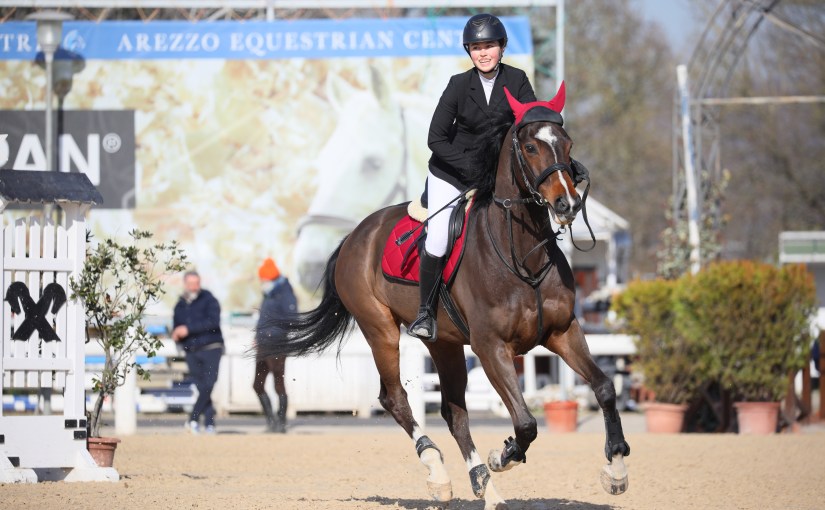
At the fairgrounds, my daughter watches others compete until the last minute, and then has to rush to tack up. The sheen of her boots or whether she remembers her gloves don’t worry her—she has ridden a horse five or six days a week for most of the past decade so the ceremonial aspects barely register. In the warm-up ring, while other instructors shout last minute advice, hers—in a knobby knit hat and fluorescent sneakers—only nods. Cantering around, my daughter holds her shoulders at an angle that evokes her father, more even than the expression on her face does—one of focus on the movement, of consciousness of a flow through her and through the horse as if through one body. She jumps an oxer, then she and her horse exit the tent and cross the piazza to the competition arena. 

When she was six months old, I would hand her up to her father atop King and he would ride out into the meadow, one hand holding her in the saddle and the other holding the reins. As soon as she could walk, she liked to feed King his oats, holding the bucket while he ate. Later, she rode while her father held a lead line, and soon, he unhooked the rope and she rode by herself, while he watched from the center of the paddock, the horse–mystifyingly to me–obeying the commands of those little limbs.

My sister taught me to ride when I was 7 or 8, in our paddock at home, on her Appaloosa, and until I came to Italy at the age of 31, my only other occasion to ride was an ill-conceived gallop through the Fontainebleau forest while studying in France, for which my group was upbraided by the owner of the sweat-drenched, foamy-mouth, terrified horses we had borrowed for the afternoon. Still, when I moved to Italy, I agreed to ride, if only to flank my new husband in his favorite pursuit.

That first winter, he would home from work at lunch time, and we would ride together, in the ring set up in the olive orchard, on a terrace that eventually became part of our vineyard, or we would set off through the wooded hills behind our house, our horses equally as surefooted on the wet leaves and moss-covered rocks of the outward bound stretch as over the muddied, boar-ravaged fields of the charge toward home. A mile or two from our property was a 17th-century villa and its private woods, hundreds of acres of wide trails dotted with stone grotesques, intersecting at carved grottos or archways, crowned by a hermitage at the top of a steep, rocky trail that afforded a view of the back of the villa, its formal gardens, our property lower down and the valley below, all the way to the Monte Amiata south of Siena.

My husband never said where we were headed, nor would he agree to a set time limit for our ride, thereby enhancing the sense of adventure. His horse, Russ, was skittish and reared or tried to take off if a pheasant rose from the brush, whereas mine was calm, though she tripped occasionally, due to an old injury, sending me forward hard onto her neck if I was distracted. My husband reassured me: if I stayed with her, I would be fine. 

He participated in weekend shows, all over Tuscany, for which I would pack a picnic lunch while he loaded his horse and his tack into the trailer. I watched him compete in Arezzo, Migliarino and Pontedera, hanging on the ring’s barrier in wintery winds or cracking heat, Russ’s sheer size making their grace all the more moving to me. He never bothered to braid Russ’s mane, and he wore a tweed jacket rather than the regulation white britches and dark coat—and won all the same.

My (now ex-) husband learned to ride as an adult, although he had always wanted a horse, and grew up in what must be one of the most horse-loving cities in the world, Siena. He was clever and courageous with horses out of necessity: he could not afford high quality jumpers. He had bought Russ from his friend and competitor Alessandro when a stress fracture to Russ’s hind hoof was revealed: Russ might never suffer an outright injury but nor could he be sold for the mid-five figures that his breeding merited. And he bought King, an Irish thoroughbred, as a two-year old, after he had been discarded as a race horse, for a thousand euro.

Over the years, I paid close attention to horses and riders at practices and at the shows we went to, to figure out what makes for a good technique—how the rider holds herself, the angle of her back, the length of the reins, where she looks; how the horse holds its head, whether he jumps way over the rail or barely clears it, how tight his turns are. I thought that, eventually, I’d be able to comment if not expertly than at least without saying the absolute wrong thing. But whenever I’m convinced I’m watching a rider whose reins are too long and a horse that’s slow and disobedient, my daughter will say under her breath, “She’s rides well,” or “Cavallo bravissimo!” In the wine business, where I’ve spent most of my professional life, you can learn a lot through direct observation—looking, smelling, tasting. It would seem that with horses, it’s different, because after all these years, I really can’t tell the Thoroughbreds from the nags, the novice riders from the champions. 

On the other hand, I’ve become an expert on fairground comforts, having figured out that Pontedera has better cappuccino but that Arezzo’s tramezzini win out. Arezzo is more chic, too, with large, sandy, white-fenced rings, snug stalls and boutiques where, as I’ve learned first hand, you can pay double for a crop to substitute the one you forget to bring. 

At the barn or at shows, I try to emulate the horse moms who were or are riders themselves. I offer to comb out the tail, fasten the girth, or give my daughter a leg up. I would be proud to lead the horse around for a cool down or a warm up or, heck, a show off! But, usually, my daughter steps around me, suggests I go get a cup of coffee or reminds me to take a video when she rides, so I head out to ringside to watch the others, until my daughter enters the ring. I have seen her ride a hundred times, and yet, when they trot in, I am always struck by their beauty, my daughter’s long legs, her sharp glance and the soft curls under her hat, King’s narrow shoulders and elegant proportions, the arc of his neck—poetry in motion.

The Mediterranean Diet

Thanks to high cholesterol, I recently spent an hour at the Ospedale Universitario in Siena, listening to a cardiologist preach the importance of diet, exercise and stress management, whereupon I confessed partially to my sins: the occasional morsel of cheese, the obligatory wine business dinners, the impossibility of scheduling time for exercise. The doctor gave me a knowing smile and pointed out that Clinton, Bush and Obama had regularly gone jogging on the White House grounds. Was I busier than the leaders of the free world?

Nothing the doctor said was news to me. Although my mother’s mother had been a meat-and-potatoes devotee, my own mother is not a particularly keen cook. I remember dinners of spaghetti with meat sauce, picnics with broiled chicken and the right to ask for steak and peas on my birthday, but my childhood memories are free of the intense associations today’s foodies claim. I had a sweet-tooth, which Mom’s orange juice-wheat germ cake (the only dessert in her repertoire) addressed, as did my father, who ate rows of Fig Newtons while watching the ball game on TV.

Although she was not into cooking, my mother had strong views on health. My childhood was peppered with snide references to “glop” (her term for any packaged food), as well as with her various tenets: “Shop the outer aisles of the supermarket—where the fresh foods are kept;” or, “Park as far from the shop as you can. The walk is good for the heart.” The messages seeped in, such that, in front of the Director of Cardiology at the hospital, I could not claim ignorance of the facts.

During high school, I made myself a peanut-butter-and-jelly sandwich every day for four years, picked at my dinner and ate pizza and drank grape soda in the dormitory at 9pm, but I played soccer, ice hockey or lacrosse six days a week, and thus managed to maintain a strange “health” equilibrium. As a young adult in college and afterward, while I was working in New York City, I lived on coffee, plain bagels and non-fat frozen yogurt and worked out only sporadically. I am not sure I was unusual in my habits: does anyone think about cardiovascular health for its own sake at age 23?

Ever since au-pairing in the southwest of France at age 15, I had had my eye on Europe. I remember Madame Geoffroy, whose children I looked after—rail thin, deeply tanned, her movements so graceful and deliberate that she seemed to be on the verge of dozing off—padding into the house from the pool in her red one-piece bathing suit and strand of pearls to pull a rôti de porc out of the oven and uncork a bottle of Graves Blanc. She was just what I wanted to be—luxe, calme, no volupté.

My fantasy bloomed when I moved to France in 1994 and was told not to hold back, that my body would “get used” to eating a cheese course after every meal, and, a year later, to Germany, where the young couples my first husband and I were friends with loved eating the dishes I had perfected since that summer at the Geoffroys’: creamy coq au vin, meaty daube and buttery gratin dauphinois. Occasionally, I jogged with a friend in the Englischer Garten; more often I dined out on an expense account. In theory, my move to Tuscany in 2001 brought me to the epicenter of Mediterranean living: excellent weather year round and the consequent active lifestyle; rivers of olive oil and oceans of red wine; seasonal, home-grown vegetables and pasta anchoring every meal. I had all of that, but while true to the letter, that description misses the point.

A typical Italian breakfast consists of cookies and coffee, or “orzo,” a caffeine-free coffee facsimile given to children, a meal my mother would call “empty calories.” Lunch is pasta, which, if served with tomato sauce, elicits the question (in our home), “Who’s dieting?” Dinner is a roast with potatoes; dessert is cookies again, this time with wine instead of coffee. Weekend lunches and dinners are often preceded by an aperitivo—a glass of wine, a few slices of ham or cheese, a handful olives. As a friend of mine succinctly puts it, in Tuscany, the bread is white and the meat is pork.

There is nothing immoderate about our routine: no snacking, no fast food, almost no butter. And vegetables do play a role, especially in summer when they are eaten, occasionally, neither fried nor beaten into a flan. But all the while the cardiologist spoke that day in the hospital, a pyramid loomed in the back of my mind—you know, the one from the FDA, with the layers of foods—whole grains at the wide base, fruits and vegetables just above, and all the “glop” at the tip? My mom taped a picture of that pyramid to our refrigerator door sometime around 1974, and referred to it throughout my childhood and adolescence, whenever my sister, father or I asked for junk food or sweets. Listening to the doctor, I started to realize that the three months of eating our garden tomatoes each summer may not be fully cancelling out the effects of the other nine months of the year’s diet of pecorino, prosciutto and Prosecco.  

The results of my blood test confirmed this: my cholesterol was 260. It turns out, staying well is not only a matter of mindset or balance or luck. I cannot see my blood vessels clogging, but they probably are. My bones and muscles feel fine, but then, I sit at a desk all day! How would I know how they are doing? Eating healthily and exercising never feel like urgent “to dos,” which is why I have put them off, for too long.

“Three months to improve,” Dottore Mondelli told me, “or you’ll need to start taking statins.” So I am trying: no spare ribs or salami, no Fiorentina steak and no cheese (ouch)—and I am looking to my dad for inspiration. He is 98 years old, and his cholesterol is 147. He listens to my mom and mostly follows her advice as far as eating is concerned. Still, he has lived in the country for years. Could it be that the real reason he’s so healthy is simply all that fresh air?

Growing Green


vegetables
It’s planting season in Tuscany, the time of year I think of my role-model and rival in all things green: Mario, my former father-in-law.

When I came to Tuscany in January 2001, Mario had just retired, and he and my-mother-in-law still lived in Siena. He would come out to our house in the country for the day, though, and I would cook him lunch, a primo and a secondo, which he ate in the upstairs kitchen while I stared at him across the table and tried to make out what he said in those first weeks of submersion in Italian. “Don’t bother,” my husband said. “He garbles. No one understands a word.”

Sixteen at the outbreak of war, Mario never had to fight, because his father had been wounded in the First World War. His parents were farmers, so Mario and his brother Marcello kept on eating chickens and eggs and vegetables throughout the war, while in town food was scarce, only really waking up to the conflict when a bomb dropped through their roof, down through the floor of their bedroom into the kitchen, rolled out the door and across the lawn and came to a stop at the edge of the woods, unexploded. The four of them, and soon the neighbors, stood in a circle around it, staring skeptically and wondering what to do. Finally, Mario and Marcello picked it up and carried it into the woods.*

Continue reading Growing Green

Corso Downhill

Walking along the corso (or main street) this holiday season, it strikes me how much has changed in Siena since my first Christmas here fifteen years ago, and I find I am nostalgic for the relatively young, old days that I knew.

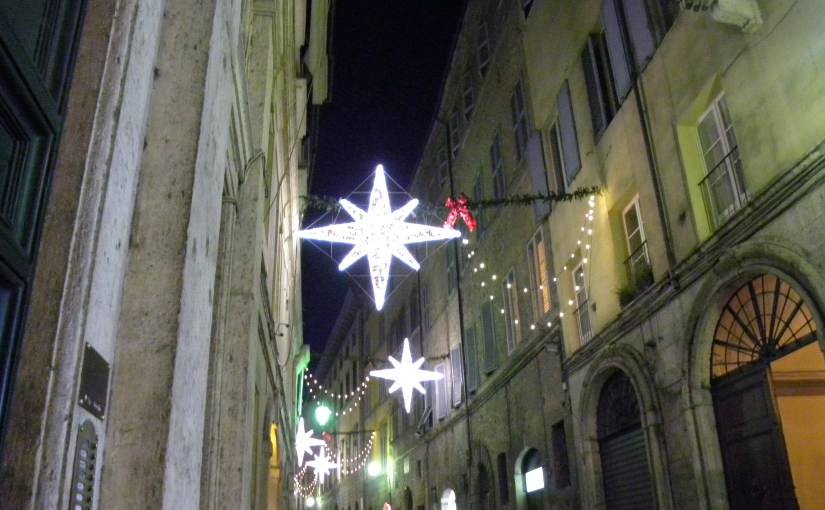
Then, there were no public Christmas decorations to speak of, other than the Monte dei Paschi tree in Piazza Salimbeni. Although I like the garlands now hung at intervals along the main shopping streets, those inflatable climbing Santas do not add much to Siena’s splendid medieval façades. Here, Christmas used to be a quiet season, often mild and rainy, the Sienese more caught up with finding a good capon or boasting of the double-digit numbers of guests they would cook for than with gifts, cards or light displays. But it is not just Christmas that is becoming Anglo-Saxonized; the town itself is changing. Continue reading Corso Downhill

Playing by the (Italian) Rules

A friend of mine has a very valuable car. It’s a Fiat Punto with over 250,000 km on it, a dent on one side and a door that doesn’t close properly on the other. That might not seem very glam, but here’s the thing: it’s still registered to his ex-girlfriend, an Australian who left Italy in 2008. He parks it wherever he wants.

You wouldn’t think that using a car in a town like Siena (60,000 people) would be particularly problematic, but Bernardo devotes plenty of time to devising ways to drive under the telecameras at the city gates without getting a ticket (for example, with the hatchback open, so the camera can’t see the license plate number) or park near his office in the center of the pedestrian zone without paying. Most of the time he uses (illegally) one of the half-dozen spaces in front of the pricey hotel across the piazza from his office. He once told me he “knew some guy” there, who kept an eye on his car. You can park in the public lot next to the hotel for 60 Euro cents an hour, so it hardly seems worth asking the favor, but I guess for some the principle of free parking matters a lot.

If Bernardo arrives late, and the hotel slots are full, he parks (illegally) around the corner in front the courthouse, putting a handicapped-parking pass on his dashboard. The original pass belonged to his Aunt Silvia’s neighbor, Lucia, a blind woman who lives across the hall in their apartment building near the Duomo. Bernardo had his aunt borrow the pass now and then on his behalf, and when color laser printers became relatively common, he made himself a pretty good copy. Continue reading Playing by the (Italian) Rules

The Butcher, The Baker, The Candlestick Maker

Life in provincial Tuscany involves a cast of what seemed at first like supporting characters but, fifteen years in, have become in many ways the people I know best, simply because we’ve been through it all—together.

candlesticksIf you like antiques, you had better like carpenters, of which, here in Siena, there are a confusing variety of specialists. There’s the one we call “quello bravo,” whom we hired to make cabinets out of some three-hundred-year old, massive chestnut shutters. Then, there are the two who repair antiques, one rebuilding the damaged section, the other, called the “shiner,” who buffs or waxes or polishes the reconstructed section so that it blends in with the old. There used to be yet another carpenter, whom we called the “candlestick guy,” because the first time I went to see him was about a pair of termite-stricken antique altar candlesticks. He specialized in anything very old, or very precious, or very small.

When I got a dog last year, all these carpenters seemed pleased. Animal lovers, I thought, until one of them explained, “Dog owners are my bread-and-butter.” I didn’t make the connection until Kaya, my Maremman Shepherd puppy, chewed through the bottom bar of a four-hundred year-old chair.

Continue reading The Butcher, The Baker, The Candlestick Maker